
This guide contains affiliate links. If you buy through them, we may earn a commission at no extra cost to you.
Ricoh GR HDF vs Standard: Is the Highlight Diffusion Filter Worth It?
Ricoh sells two GR cameras in two versions each: a standard model and an HDF model. The HDF versions cost $100 more and look nearly the same, yet in Japan, where we are based, the GR IV HDF is one of the hardest cameras to buy: Ricoh sells it only through its own store and website, and only by lottery. So is the filter worth it, and what do you give up? This guide explains it with Ricoh's official descriptions and specs (October 2026).
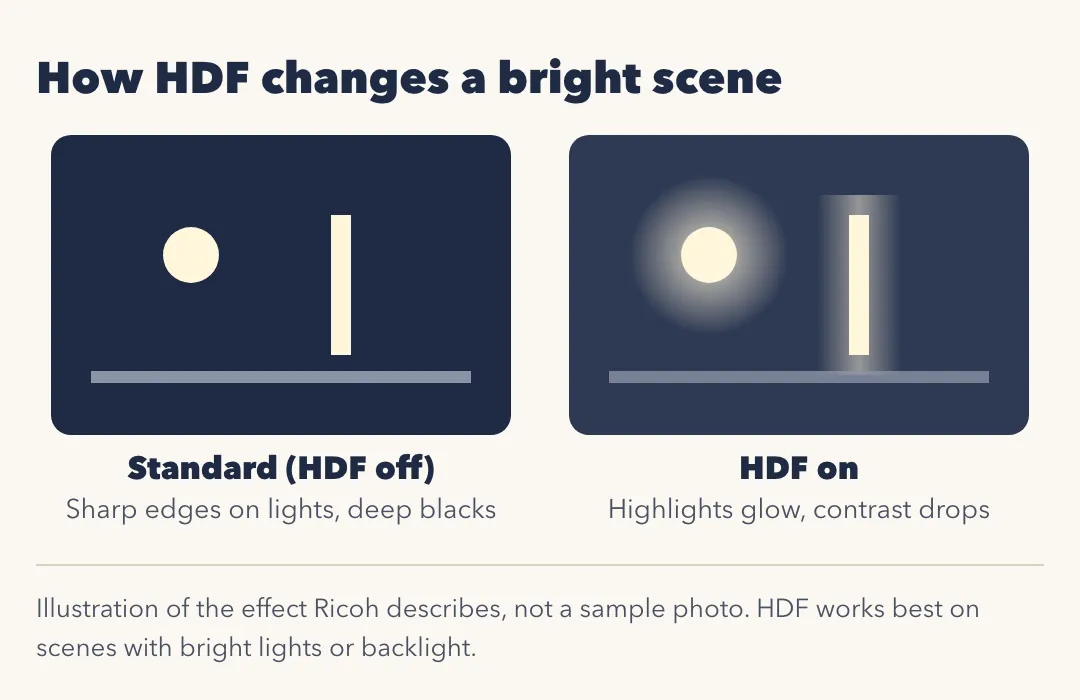
What the Highlight Diffusion Filter does
HDF stands for Highlight Diffusion Filter. Ricoh, which is also one of Japan's big printer makers, says the filter is printed using its inkjet printing technology and built into the camera. It diffuses highlights, softens the area around them and lowers overall contrast. The effect is strongest where there is bright light in the frame: street lamps and neon at night, sunlight through a window, a backlit face. Ricoh says it pairs especially well with the camera's "Cinema" color settings, for a more evocative, movie-like finish straight out of the camera.
It is similar in spirit to the diffusion filters some photographers screw onto their lenses, but here nothing sticks out of the pocketable body. You switch it on or off with the Fn button on the back. With HDF off, the camera takes the same photos as the standard model, so you are never locked into the soft look.
What you give up: the ND filter
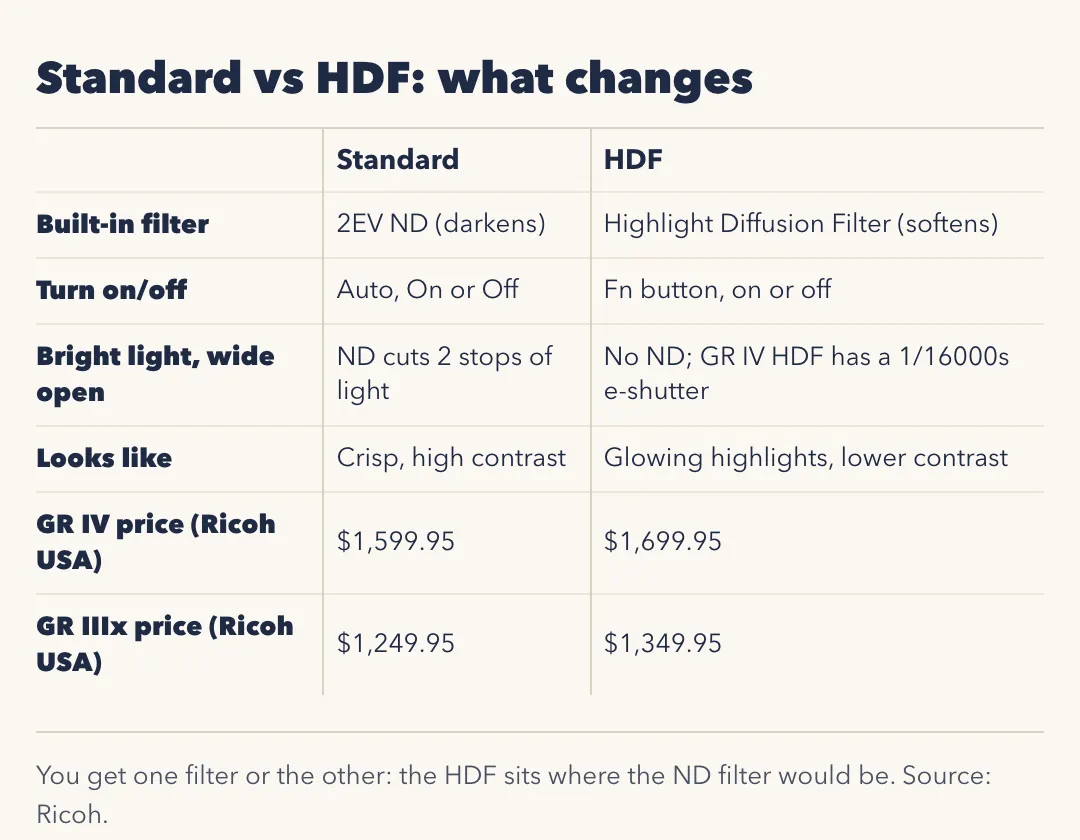
The HDF goes where the ND filter would be, so an HDF camera has no built-in ND. The ND filter cuts 2 stops of light, which helps when you want to shoot at F2.8 for a blurred background in bright sun, or use a slow shutter for motion blur in daylight. Ricoh says the GR IV HDF has a 1/16000s electronic shutter, which covers most bright-light situations at F2.8, but slow-shutter daylight shots are easier with the ND.
Why HDF is so hard to get in Japan
In Japan, Ricoh says the HDF models are sold only through its own Ricoh Imaging Store and its GR SPACE TOKYO store in Harajuku, not through ordinary camera shops. At GR SPACE TOKYO, the GR IV HDF is sold by lottery: the current round takes entries from October 21 to November 22, 2026, only from people who live in Japan, with photo ID checked in person and one camera per person. Winners hear on December 5 and must collect it at the store. In the US, there is no lottery: when we checked, Amazon.com sold the GR IV HDF directly.
GR IV HDF vs GR IV
Apart from the filter, Ricoh says the GR IV HDF matches the GR IV: 28mm F2.8, 25.7MP, 5-axis stabilization and 53GB of built-in storage. Ricoh USA lists the GR IV at $1,599.95 and the HDF at $1,699.95. There is also a practical difference: when we checked in October 2026, Amazon.com sold the GR IV HDF but not the standard GR IV. If you like the glow even occasionally, the HDF gives you both looks in one camera, and it is the easier GR IV to get on Amazon.
Prices and stock on Amazon change often. Look for listings shipped and sold by Amazon.com; some GR listings are imports from other sellers.
GR IIIx HDF vs GR IIIx
The 40mm pair works the same way: the GR IIIx HDF ($1,349.95) swaps the ND filter of the GR IIIx ($1,249.95) for HDF, and has a silver shutter button so you can tell them apart. Both are sold by Amazon.com. A 40mm view plus HDF suits portraits and close street scenes, where the glow falls on skin and window light. Ricoh says Japanese production of the GR IIIx models ends with October 2026 shipments, so this pairing will not be around new for long.
Who should get HDF?
- Get HDF if you shoot a lot at night or against the light, love a soft, cinematic or film-like look straight out of the camera, or want to skip editing.
- Get the standard model if you want maximum sharpness and contrast, shoot landscapes or architecture, or use slow shutter speeds in daylight.
- Not sure? HDF turns off, so the HDF model can also take standard photos. What you lose is only the ND filter.
Still deciding between 28mm and 40mm? See GR IV vs GR IIIx, or start from which Ricoh GR to buy, where we also cover the GR's 30th anniversary edition.