
This guide contains affiliate links. If you buy through them, we may earn a commission at no extra cost to you.
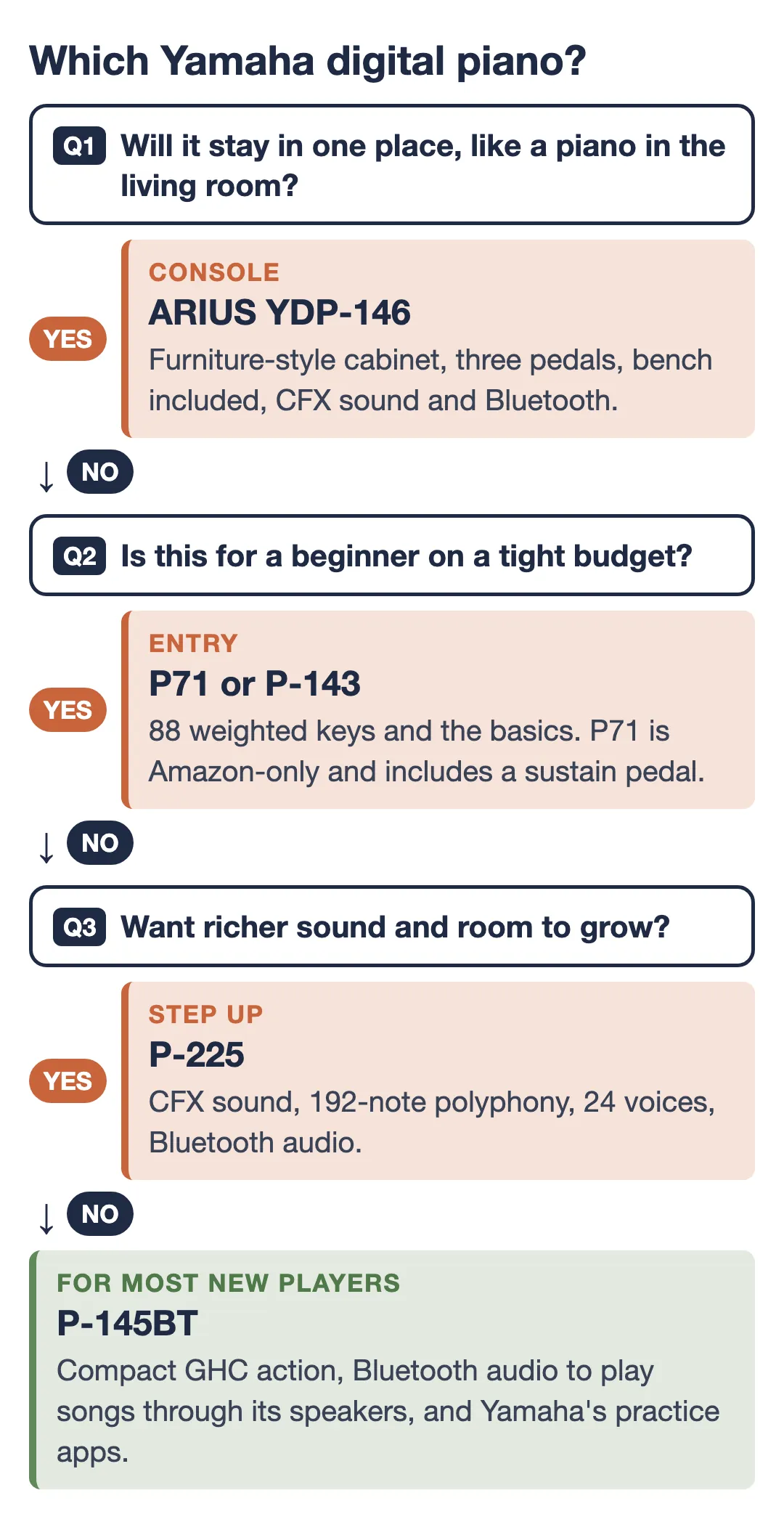
Which Yamaha Digital Piano Should You Buy? P71 vs P-143 vs P-145BT vs P-225 vs ARIUS
Yamaha traces its roots to 1887, when founder Torakusu Yamaha repaired an imported reed organ in Japan, and it built its first grand piano in 1902 (Yamaha). Today it sells many 88-key digital pianos in the US, and the model numbers are hard to decode. This guide explains the main models using Yamaha USA's spec pages.
The models side by side
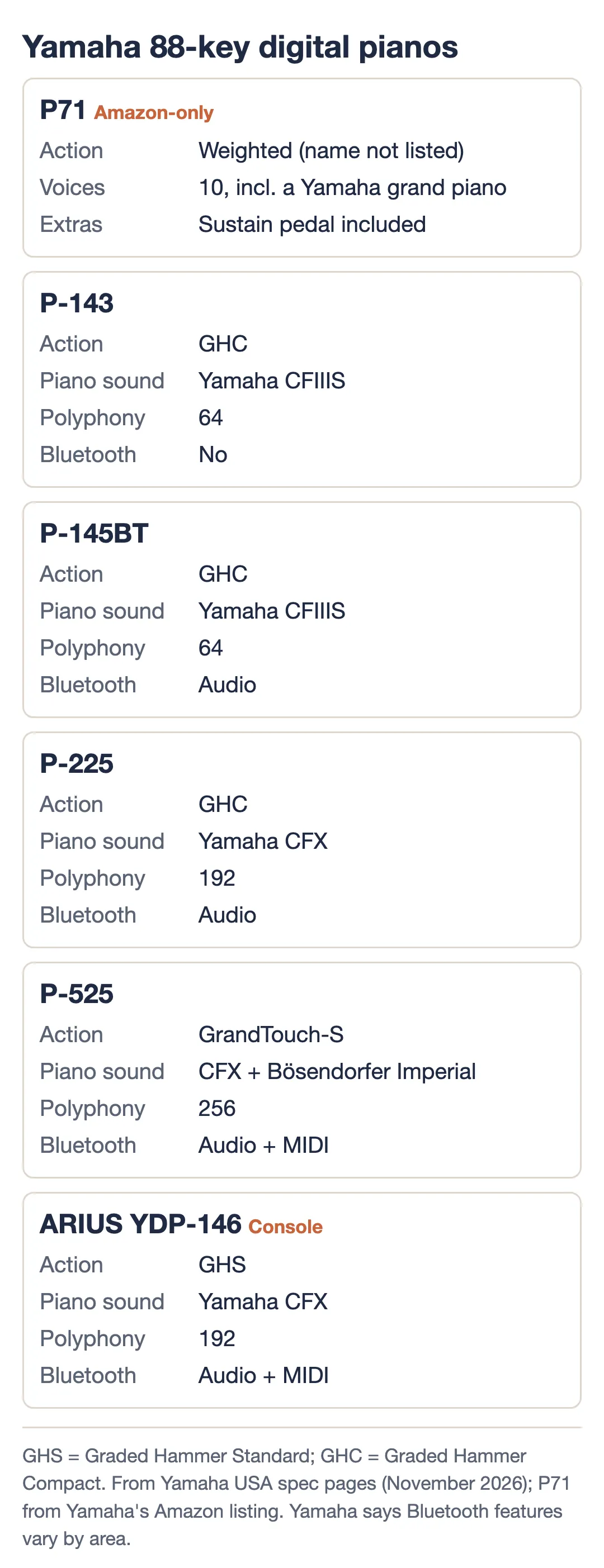
Three terms explain most of the differences. Keyboard action is how the keys feel: all of these have 88 weighted keys that are heavier in the bass like an acoustic piano, and Yamaha's Graded Hammer Standard (GHS) and the slimmer Graded Hammer Compact (GHC) are its entry actions, while the P-525's GrandTouch-S is its premium one. Piano sound is the grand piano Yamaha sampled: the P-143 and P-145BT use its CFIIIS grand, while the P-225, P-525 and YDP-146 use its flagship CFX concert grand. Polyphony is how many notes can sound at once; 64 is enough for beginners, while 192 or more helps with sustained, layered playing.
For beginners: P71 or P-143
P71 is an Amazon-exclusive model. Yamaha's listing describes touch-sensitive weighted keys, 10 voices including a Yamaha grand piano, a Dual mode that layers two voices, simple one-button operation, and an included sustain pedal; its spec list closely matches the P-45 that Yamaha sells elsewhere. P-143 moves to the slimmer GHC action, with 64-note polyphony and no Bluetooth. Prices and stock on Amazon change often, so check each listing.
For most new players: P-145BT
The P-145BT pairs the GHC action with Yamaha's CFIIIS grand piano sample and 64-note polyphony, and adds Bluetooth audio, so you can play songs from your phone through its speakers and play along. Yamaha also says it works with apps like Smart Pianist and Rec'n'Share for practice and recording. For most new players, this is the one to buy.
More sound: P-225 and P-525
P-225 keeps the compact GHC action but raises polyphony to 192 notes and the voice count to 24, with CFX sound and Bluetooth audio, so it grows with a player who moves beyond lessons. P-525 is the flagship portable: Yamaha's GrandTouch-S action, both the CFX and Bösendorfer Imperial piano samples, 256-note polyphony, and Bluetooth for audio and MIDI.
A piano for the living room: ARIUS
The P-series are portable: you put them on a stand or table. Yamaha's ARIUS pianos come in a furniture-style cabinet with three pedals and a bench, so they look and feel like an upright piano at home. The YDP-146 uses the GHS action, the CFX sample with damper and string resonance, 192-note polyphony, and Bluetooth for audio and MIDI (Yamaha says this varies by area); the YDP-105 is the simpler model.
Which one suits you?
- Lowest cost, 88 weighted keys: P71 (Amazon-only).
- Most new players: P-145BT.
- Room to grow, richer sound: P-225.
- The best portable feel and sound: P-525.
- A piano that looks like furniture, with three pedals: ARIUS YDP-146.
- Only want 61 keys to start? See our guide to the PSR-E283 and other Yamaha portable keyboards; a full 88-key piano is the better choice if you plan to take lessons.