
This guide contains affiliate links. If you buy through them, we may earn a commission at no extra cost to you.
Yamaha vs Roland vs Casio vs Kawai: Which Digital Piano Brand Is Best for You?
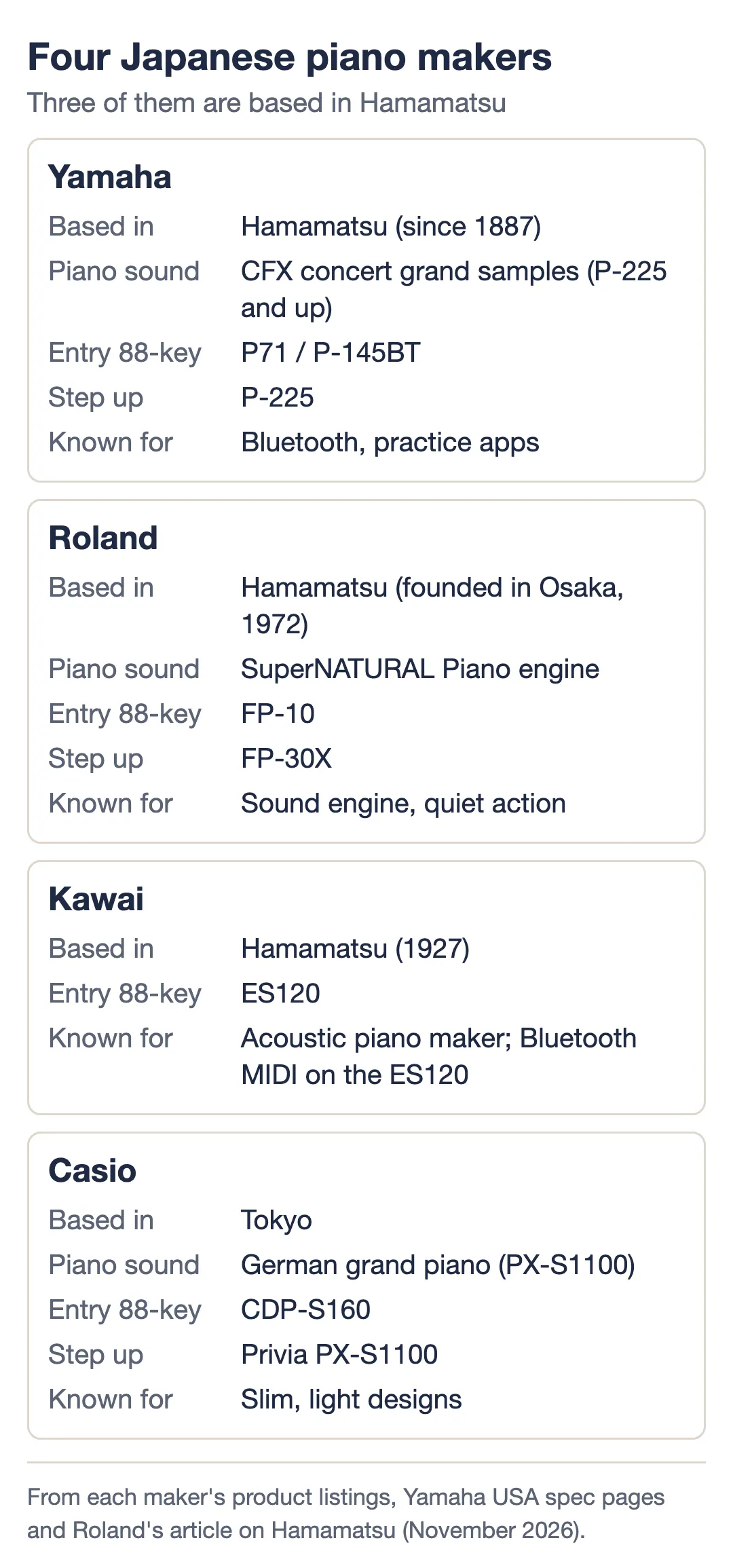
Shop for a digital piano in the US and almost every serious option comes from Japan. Yamaha, Roland and Kawai are all based in Hamamatsu, a city Roland calls "Japan's city of music" (Roland), and Casio is based in Tokyo. They share a home country but have different strengths. This guide compares the entry and step-up 88-key models from each, using the makers' own listings (November 2026).
The four brands at a glance
Yamaha: the safe pick
The P-145BT adds Bluetooth audio and works with Yamaha's apps; the Amazon-only P71 is the budget pick; the P-225 steps up to samples of Yamaha's CFX concert grand, with more polyphony and voices. Full details are in which Yamaha digital piano to buy. Prices and stock on Amazon change often, so check each listing.
Roland: the sound engine
Roland was founded in Osaka in 1972 and is now headquartered in Hamamatsu. Its pianos use the SuperNATURAL Piano sound engine. The FP-10 is the start of Roland's FP series, with keys Roland says have an ivory feel and a quiet action for practicing with headphones. The FP-30X builds on it with an enhanced sound engine, more powerful speakers and more polyphony; Roland calls it the "sweet spot" of the series.
Kawai: from an acoustic piano maker
Kawai, based in Hamamatsu, is best known for its acoustic grand and upright pianos. The ES120 is its portable 88-key model, with Kawai's Responsive Hammer Compact action, Spatial Headphone Sound, Bluetooth for both audio and MIDI, and 25 sounds. On Amazon, the ES120 was only available through other sellers when we checked, so a music retailer may be the easier place to buy one.
Casio: slim and affordable
Casio, based in Tokyo, is the value and portability choice. The CDP-S160 is a low-cost 88-key piano with Casio's Scaled Hammer Action keyboard. The Privia PX-S1100 is notably slim, with illuminated touch controls and a German grand piano sound with string and damper resonance plus 17 other tones, according to Casio.
Which one suits you?
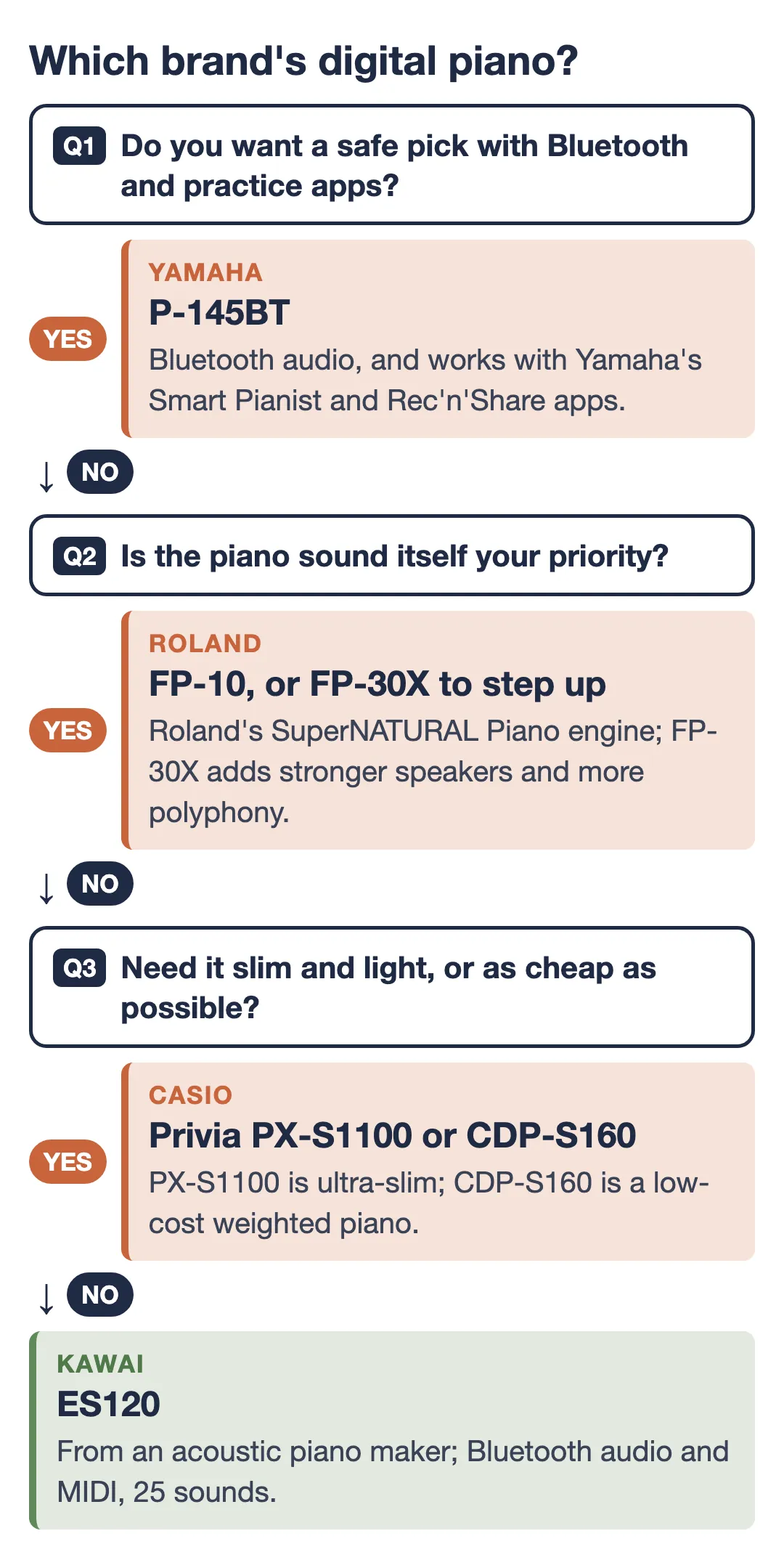
- A safe choice with Bluetooth and apps: Yamaha P-145BT.
- Sound first: Roland FP-10, or FP-30X.
- A feel from an acoustic piano maker, with Bluetooth MIDI: Kawai ES120.
- Slim and light: Casio Privia PX-S1100.
- Lowest cost with weighted keys: Casio CDP-S160 or Yamaha P71.
- Not sure you need 88 keys? See Yamaha beginner keyboards.
Related guides
Source: Roland: Hamamatsu, Japan's City of Music and Home to Roland