
This guide contains affiliate links. If you buy through them, we may earn a commission at no extra cost to you.
Shun vs Miyabi: Which Japanese Chef's Knife Should You Buy?
Shun and Miyabi are the two Japanese knife brands that most US cooks end up choosing between. Both are handcrafted in Seki, Japan's historic knife-making city, both take more than 100 steps to make, and both turn out chef's knives that are a pleasure to cut with and to look at. So which one? The short answer: Miyabi sharpens thinner and harder for the most effortless cut; Shun is a little sturdier and comes with free sharpening for life. This guide compares the 8-inch chef's knife (gyuto) in each brand's main lines, using the brands' own product listings (October 2026).
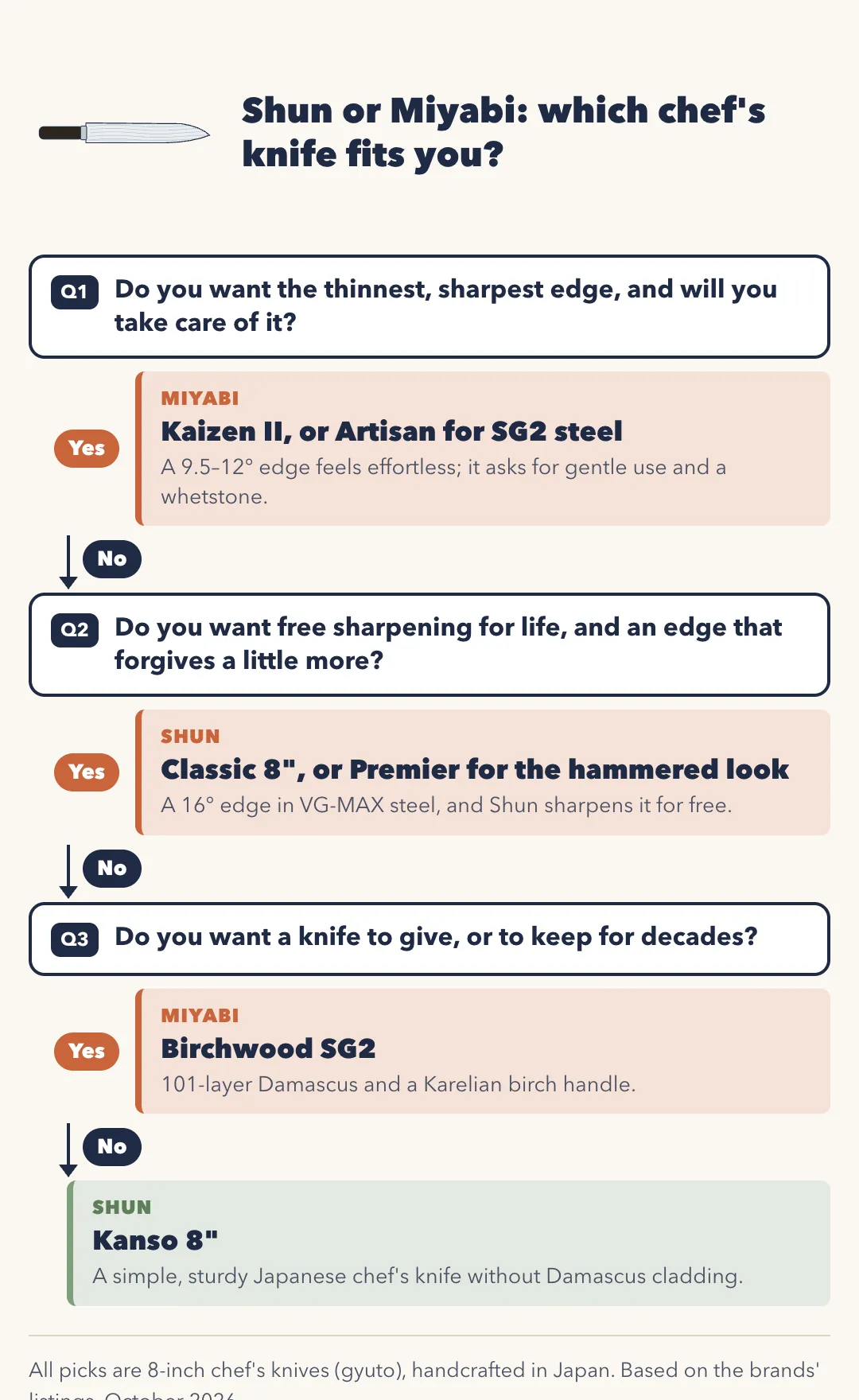
The real difference is the edge
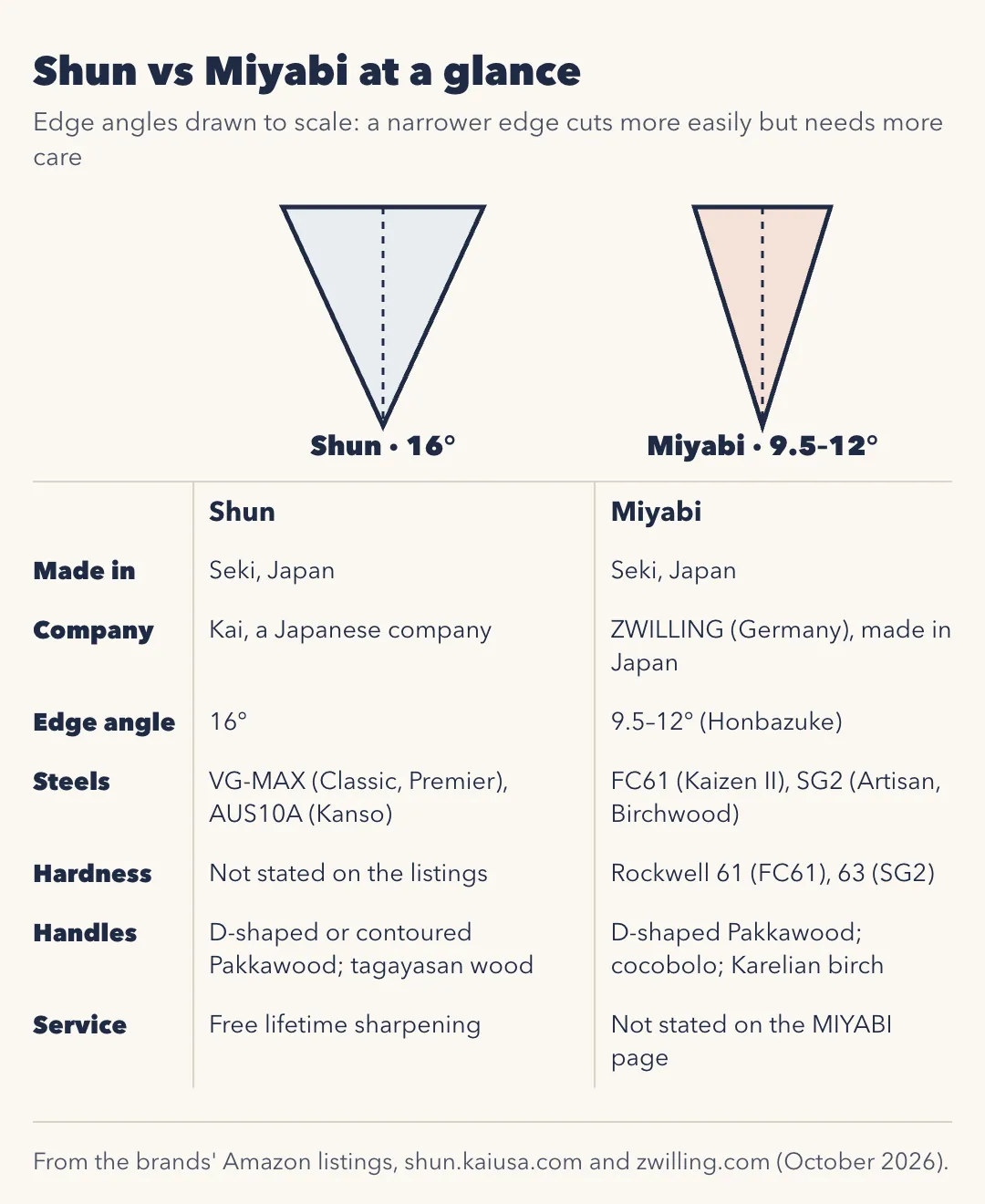
Miyabi hand-hones its blades with the traditional three-step *Honbazuke* process to an edge of 9.5 to 12 degrees, and its SG2 lines are hardened to Rockwell 63. That is a very thin, very hard edge. It falls through tomatoes and onions with almost no pressure, and it holds that sharpness a long time. The trade-off is that a thin, hard edge is less forgiving: it doesn't like bones, frozen food or twisting, and it rewards a cook who sharpens on a whetstone.
Shun sharpens its knives to 16 degrees. That is still far sharper than most knives in a US kitchen, but the slightly wider edge is a little more tolerant of everyday use. Shun also offers free lifetime sharpening, so if you would rather not learn to use a whetstone, Shun will keep your knife sharp for you.
The other difference is who is behind the brand. Shun is made by Kai, a Japanese company. Miyabi belongs to ZWILLING, the German knife maker, which makes it in Seki; ZWILLING says each Miyabi takes over 100 steps and 42 days to make (MIYABI USA). Both are genuinely made in Japan.
Shun: three chef's knives
The drawings below are simplified illustrations based on each knife's design. Prices and stock on Amazon change often, so check the product page for current details.
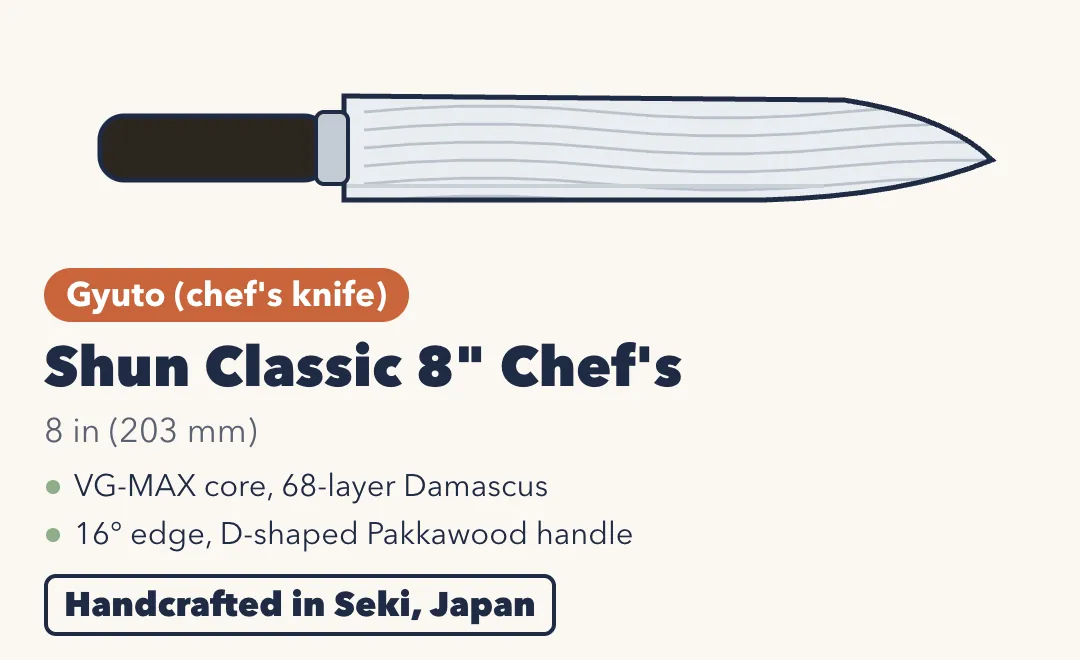
Shun Classic 8": the one most people should buy. Shun calls the Classic series the original authentic Japanese cutlery line introduced to the United States. It has a VG-MAX steel core in 68 layers of Damascus cladding, a 16-degree edge and a D-shaped Pakkawood handle that sits comfortably in either hand. Sharp, beautiful and easy to live with, with free sharpening when it needs it.
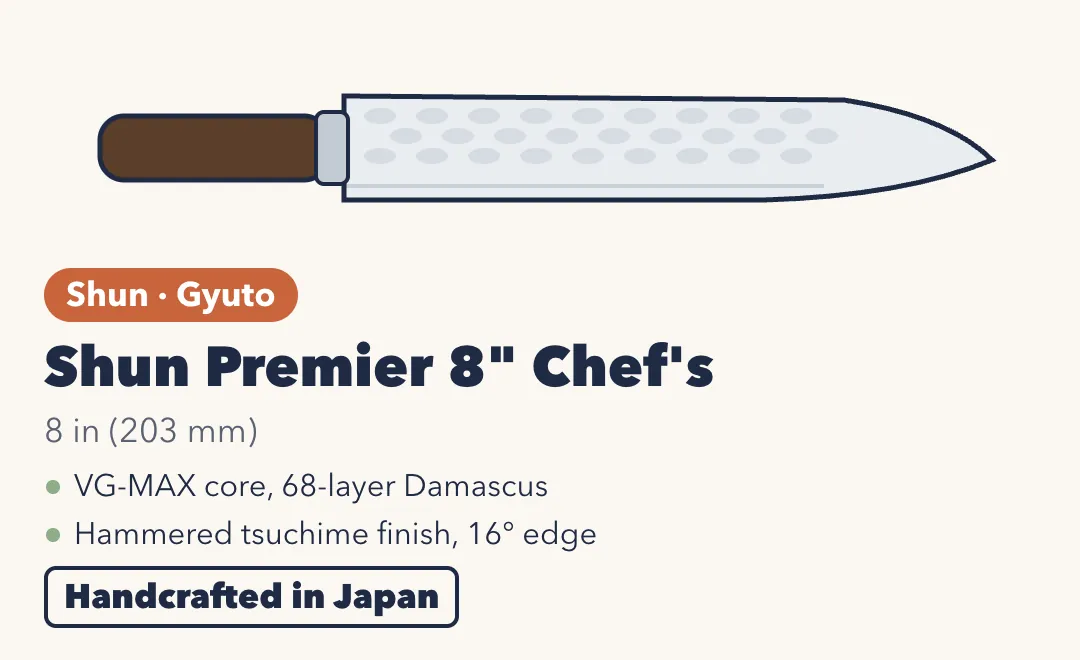
Shun Premier 8": the same steel, with a hammered finish. The Premier has the Classic's VG-MAX core, 68 layers of Damascus and 16-degree edge, but adds a hand-hammered *tsuchime* finish that Shun says reduces drag, and a contoured walnut-toned Pakkawood handle. Choose it if you like the handmade look.
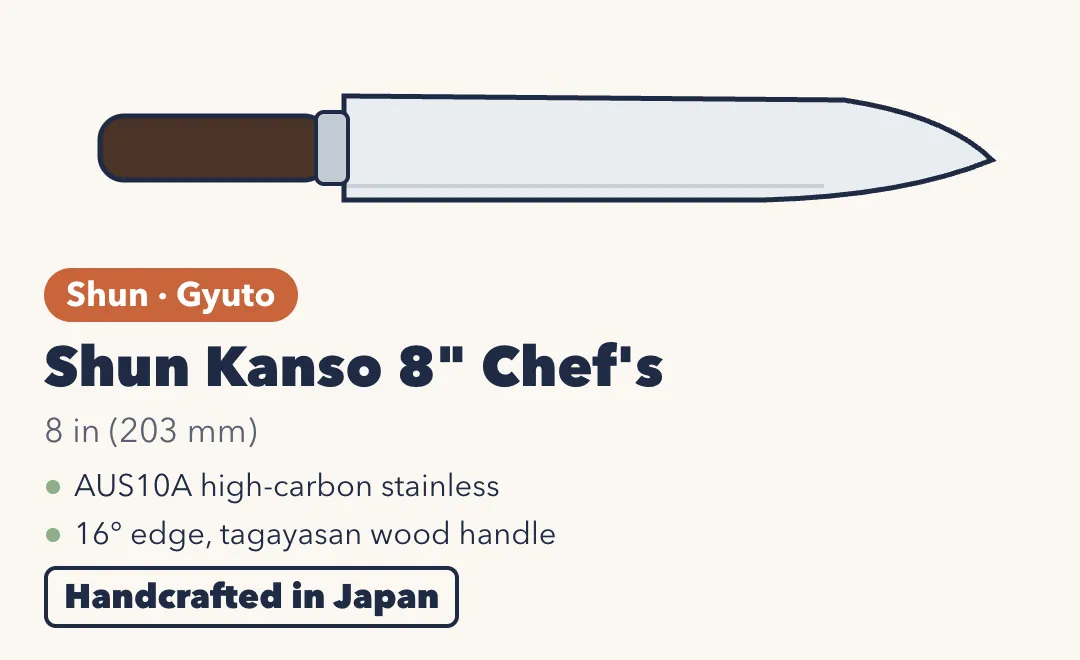
Shun Kanso 8": simple and sturdy. *Kanso* means "simplicity", a design principle influenced by Zen. Instead of Damascus, it uses AUS10A high-carbon stainless steel with a 16-degree edge, and a full-tang handle in tagayasan, known as "iron sword wood". The least fussy Shun, and the easiest on your budget.
Miyabi: three chef's knives
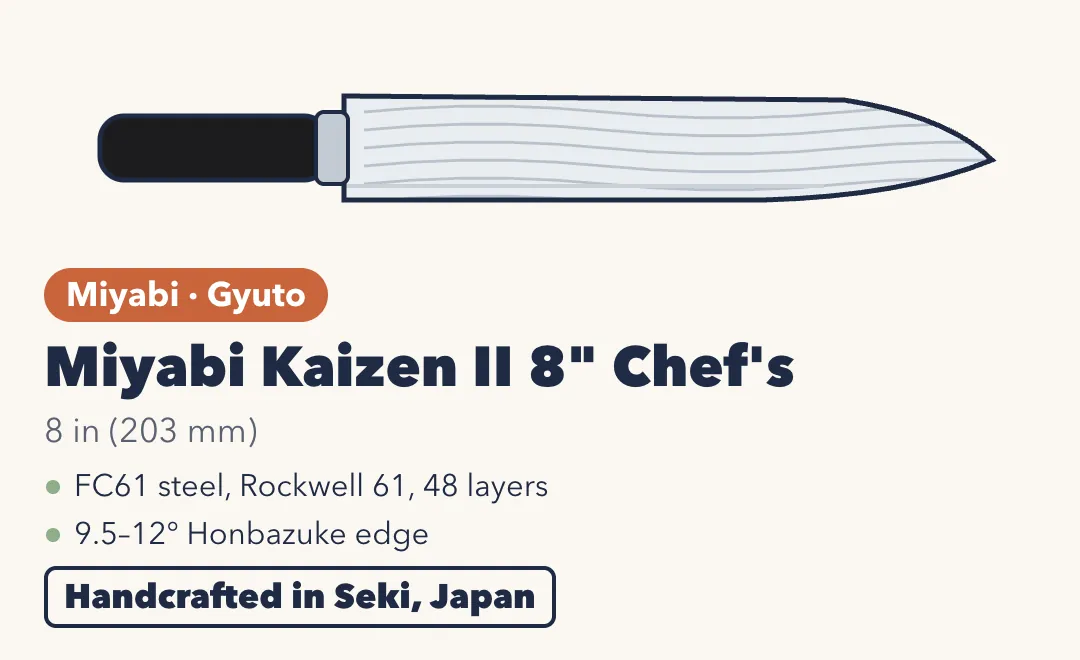
Miyabi Kaizen II 8": the thinnest edge for the money. It has an FC61 steel core with fine carbide distribution, hardened to Rockwell 61 and wrapped in 48 layers of Damascus. The blade is double ice-hardened and hand-honed with Honbazuke to 9.5 to 12 degrees, and the D-shaped black Pakkawood handle has a rounded bolster for balance. This is the knife for someone who wants Miyabi's edge without the top-tier price.
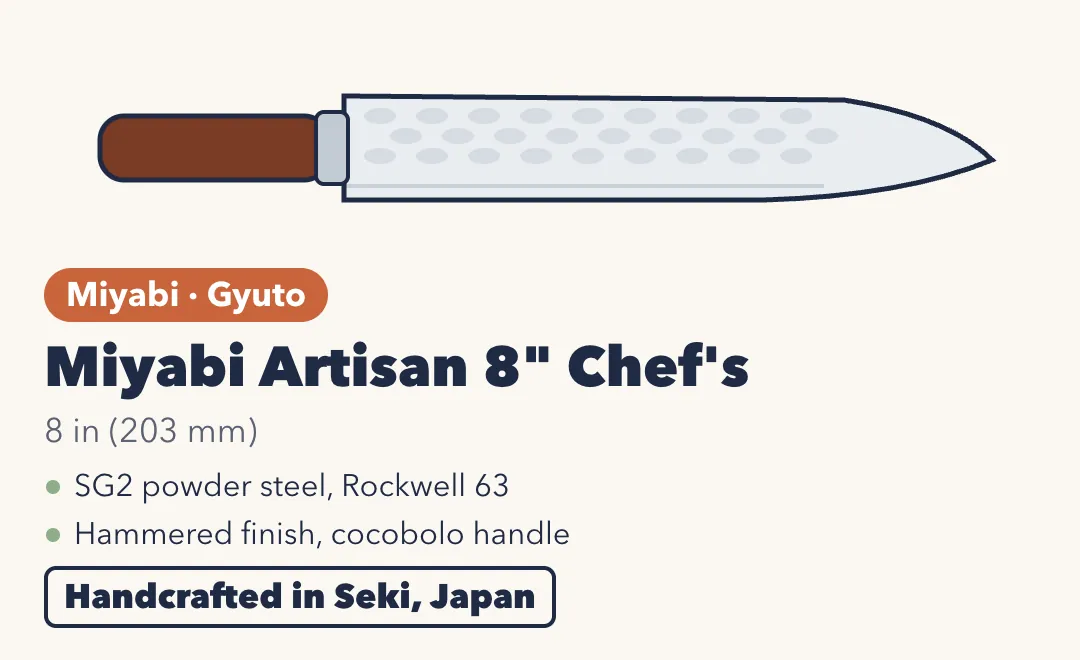
Miyabi Artisan 8": SG2 steel with a handmade look. The core is SG2 micro-carbide powder steel at Rockwell 63, with a hammered *tsuchime* finish and a D-shaped cocobolo Pakkawood handle. It is the Miyabi to choose if you want the harder SG2 steel and a knife that looks as crafted as it is.
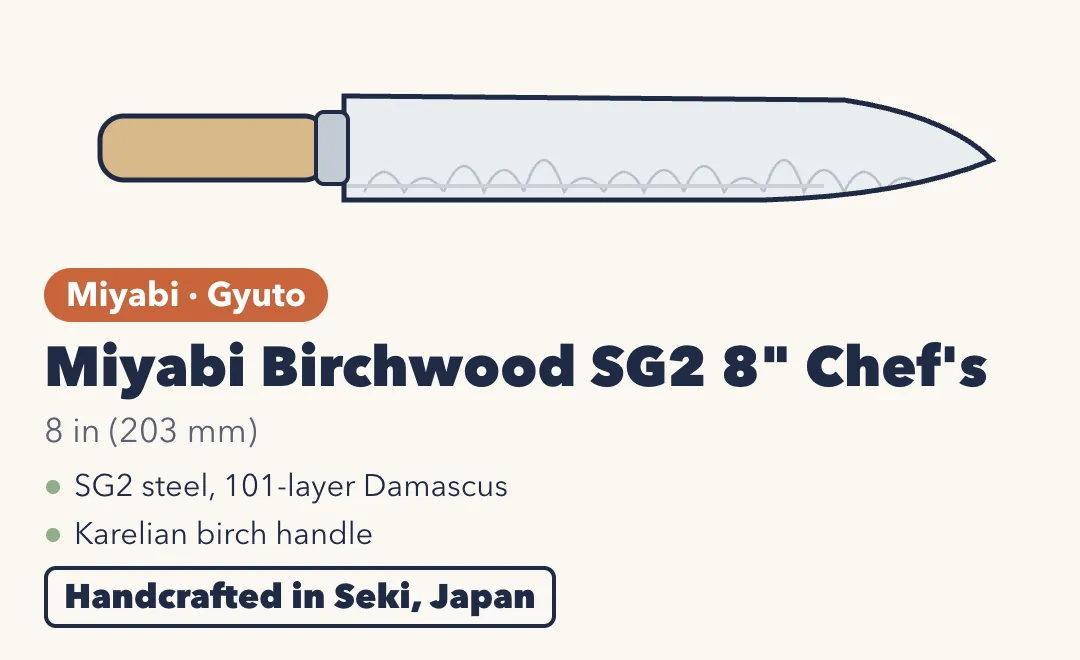
Miyabi Birchwood SG2 8": the heirloom. The same SG2 steel, wrapped in a 101-layer "flower" Damascus pattern, with a traditional Japanese handle in Karelian (Masur) birch. It is the knife people give for weddings and big birthdays, and the one you hang on the wall when you're not using it.
Matchups at a glance
| If you want... | Shun | Miyabi |
|---|---|---|
| Simple and sturdy | Kanso (AUS10A, 16°) | — |
| Classic Damascus look | Classic (VG-MAX, 68 layers, 16°) | Kaizen II (FC61, 48 layers, 9.5–12°) |
| Hammered, handmade look | Premier (VG-MAX, tsuchime, 16°) | Artisan (SG2, Rockwell 63, 9.5–12°) |
| A showpiece | — | Birchwood SG2 (101 layers, birch handle) |
| Free lifetime sharpening | Yes | Not stated |
Whichever you choose, treat it like the fine tool it is: wash by hand and dry it right away, use a wood or plastic cutting board, and keep it away from bones and frozen food. Not sure a chef's knife is the right shape? See our guide to gyuto, santoku, bunka and nakiri.
Which one suits you?
- One great knife, easy to look after: Shun Classic 8", with free sharpening for life.
- The same with a hammered finish: Shun Premier 8".
- The sharpest edge without the top price: Miyabi Kaizen II 8".
- Harder SG2 steel and a crafted look: Miyabi Artisan 8".
- A gift, or a knife for the next 20 years: Miyabi Birchwood SG2 8".
- Simple, sturdy and less expensive: Shun Kanso 8".
Source: MIYABI USA (ZWILLING)