
This guide contains affiliate links. If you buy through them, we may earn a commission at no extra cost to you.
Global vs Shun vs Wüsthof: Japanese or German Chef's Knife?
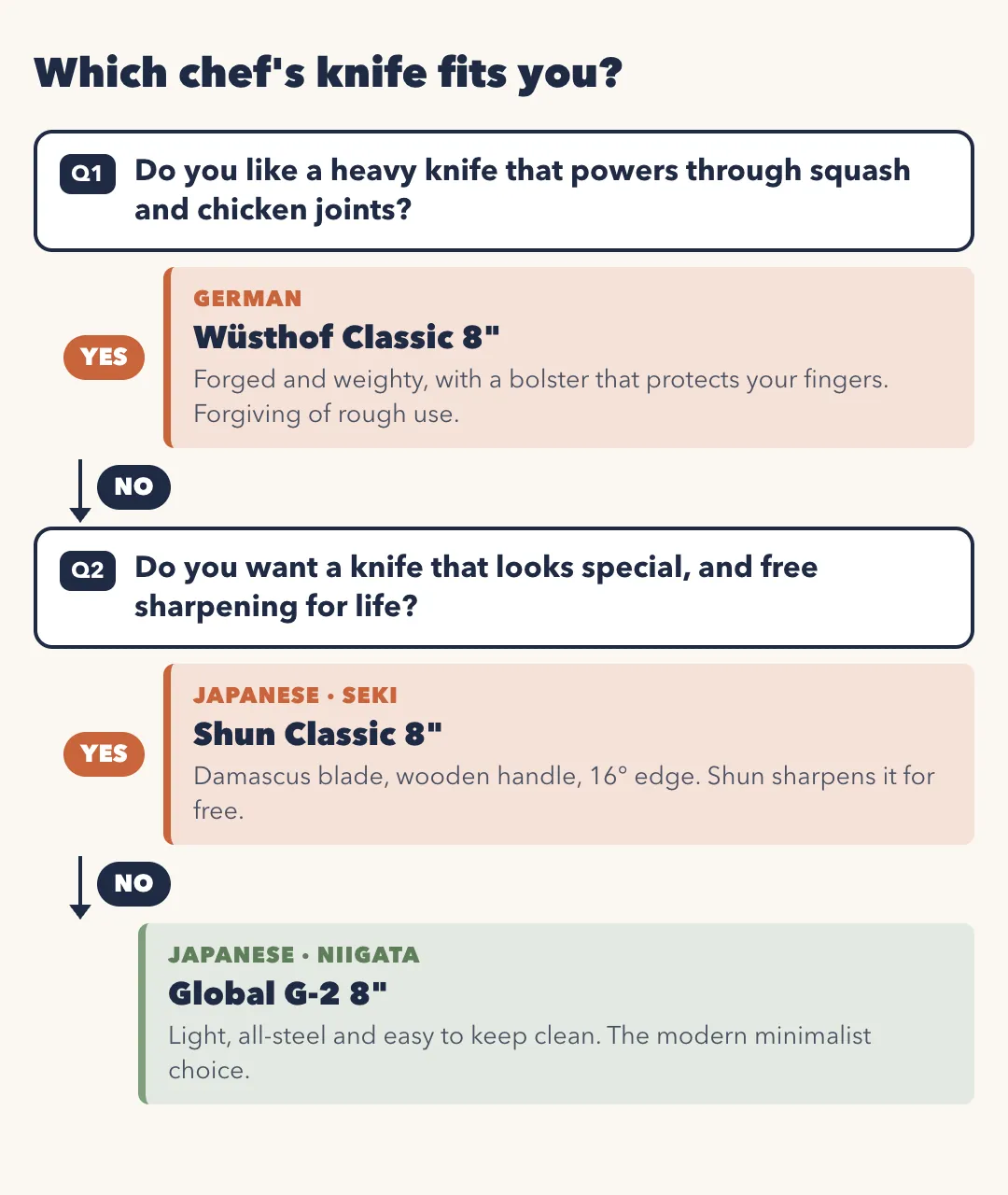
If you shop for a good chef's knife in the US, three names keep coming up: Global and Shun from Japan, and Wüsthof from Germany. All three are excellent. What separates them is how they feel: Global is light and all steel, Shun is light with a striking Damascus blade, and Wüsthof is heavier and solid. This guide compares their 8-inch chef's knives using the makers' own sites and listings, including details from Global's Japanese site that rarely make it into English reviews.
Side by side
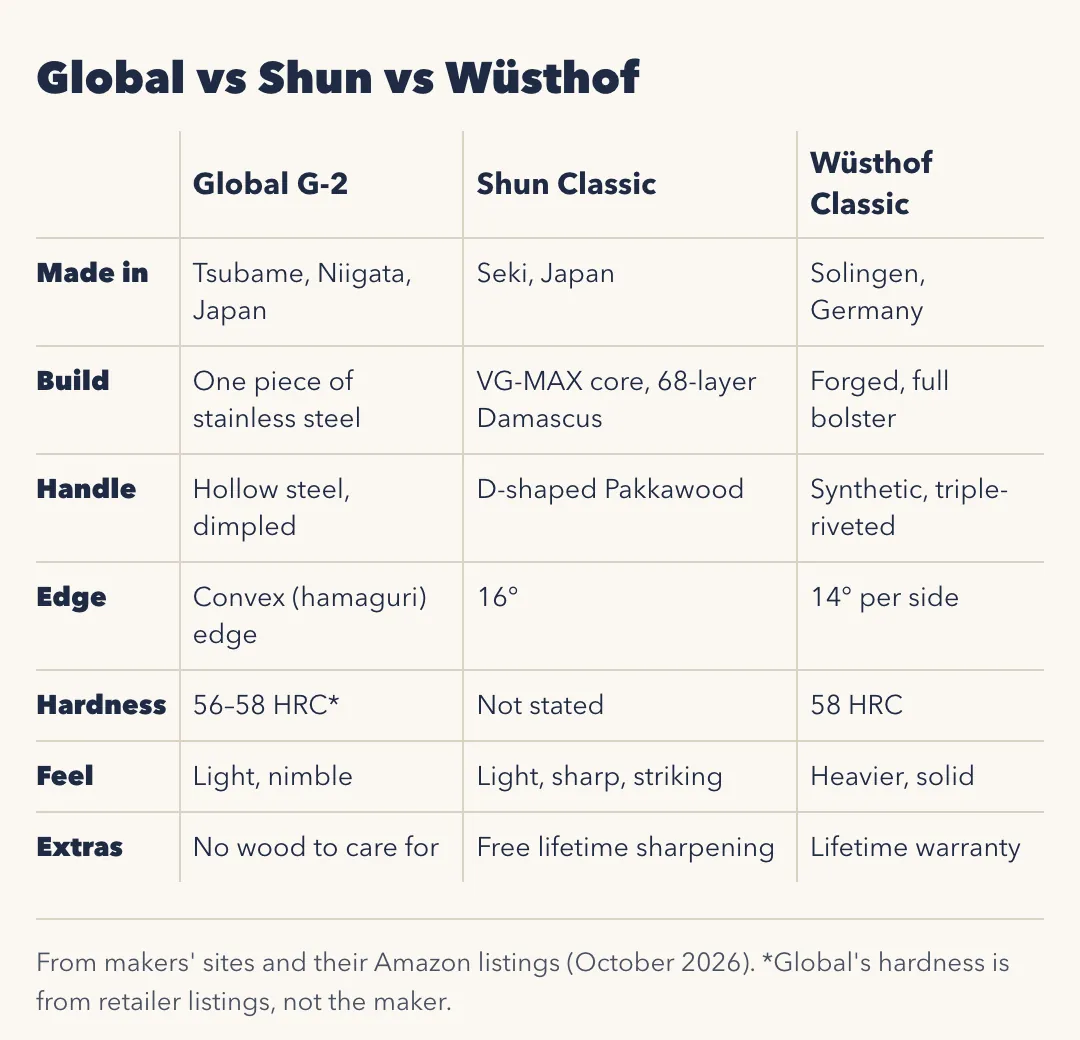
A common belief is that Japanese knives have a much sharper angle than German ones. Today the gap is small: Wüsthof sharpens its standard blades to 14 degrees per side (WÜSTHOF), and Shun sharpens to 16 degrees. The bigger differences are weight and balance (Wüsthof's forged blade and full bolster make it the heaviest of the three, at 8.5 oz for the 8-inch), the handle, and how you look after it.
Global: all steel, from Niigata
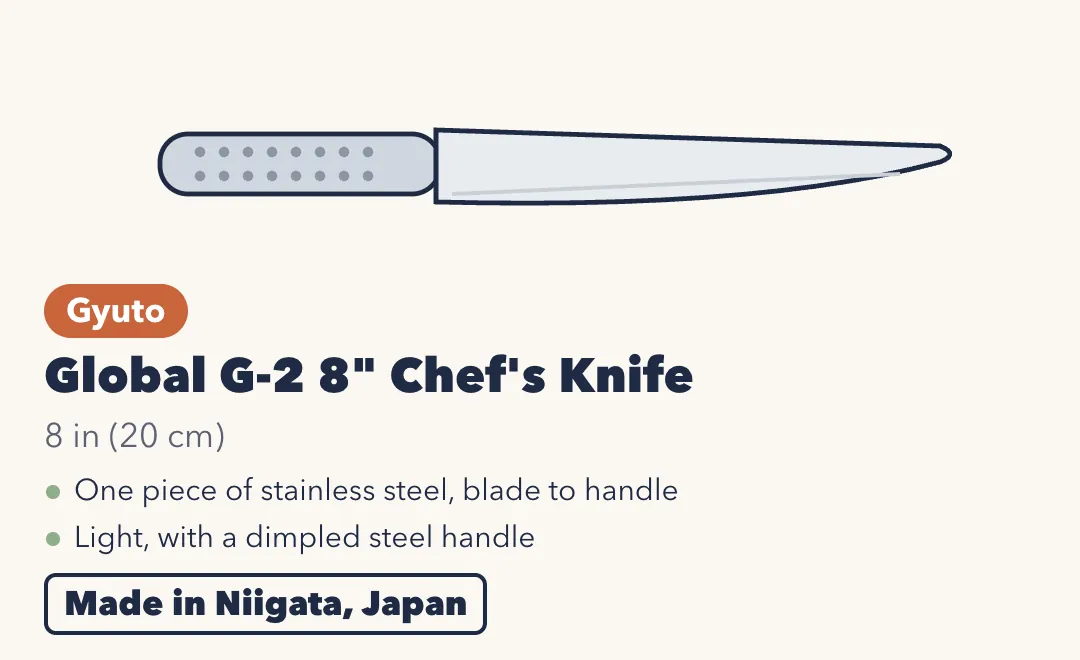
Global is made by Yoshida Metal Industry (Yoshikin) in Tsubame, Niigata, one of Japan's metalworking towns. According to the company's Japanese site, it went on sale in 1983 as an all-stainless, one-piece knife, at a time when Japanese kitchen knives almost always had wooden handles. The design, including the black dots on the handle, came from product designer Komin Yamada, and the edge is ground as a convex *hamaguri* (clamshell) edge for a smooth cut (Yoshikin). The hollow steel handle has no seams for food to get into, which makes it easy to keep clean.
- Feels: light and nimble; the steel handle is slimmer than most.
- Watch out for: some people with large hands, or wet hands, find the steel handle less grippy than wood or plastic.
- Good to know: Yoshikin sells more than 150 Global models, including a line made only for the Japanese market.
Shun Classic: Damascus, from Seki
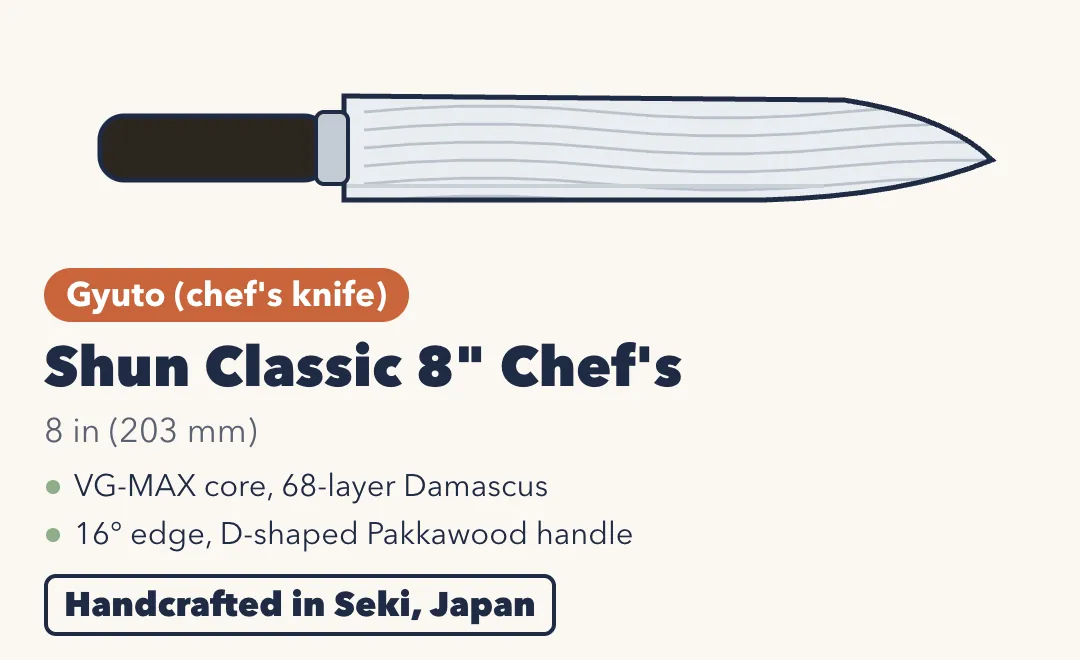
Shun is made by Kai in Seki, Japan's historic knife-making city. The Classic has a VG-MAX steel core wrapped in 68 layers of Damascus cladding, a 16-degree edge and a D-shaped Pakkawood handle. It is the most eye-catching of the three, and Shun offers free lifetime sharpening, so you don't have to learn a whetstone. Compared with Miyabi, Shun's main Japanese rival, see Shun vs Miyabi.
Wüsthof Classic: forged, from Solingen
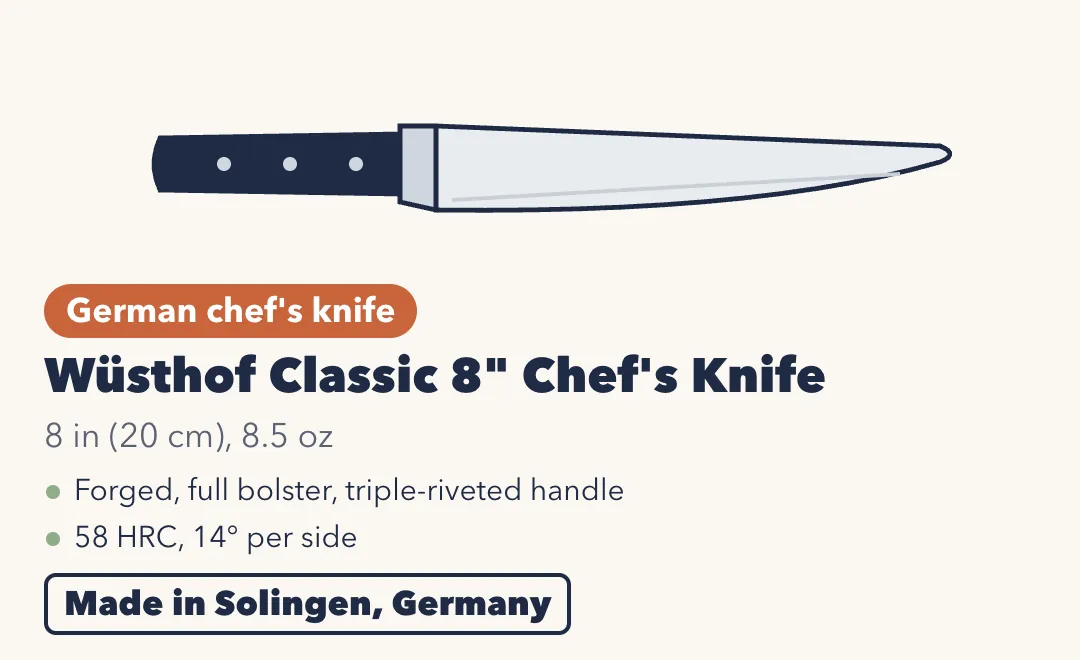
Wüsthof has made knives in Solingen, Germany, since 1814. Its listing describes the Classic chef's knife as forged from a single block of high-carbon stainless steel, tempered to 58 HRC, with a full bolster and finger guard and a triple-riveted synthetic handle; the 8-inch weighs 8.5 oz. The weight does some of the work for you on hard vegetables, and the bolster keeps fingers away from the edge. The slightly softer steel is more forgiving of twisting and the odd bone, and is easy to touch up with a honing steel.
- Feels: heavy and planted; good for rocking cuts.
- Watch out for: a full bolster runs down to the edge, so over years of sharpening the heel can need extra attention on a whetstone.
- Good to know: Wüsthof sharpens its Asian-style blades (santoku, nakiri) to a thinner 10 degrees per side.
Care: what changes between them
- All three: hand-wash and dry right away; use a wood or plastic board.
- Global and Shun: thin, hard Japanese edges dislike bones, frozen food and twisting. Sharpen on a whetstone; see our whetstone guide, or use Shun's free sharpening.
- Wüsthof: more tolerant of rough jobs; hone it regularly with a steel between sharpenings.
Want something different? Two more options
- A no-frills Japanese knife for less: the Tojiro 8.2" (210 mm) gyuto, VG10 steel, made in Japan. See gyuto vs santoku, bunka and nakiri.
- An even thinner, harder edge: Miyabi, made in Seki, hand-honed to 9.5 to 12 degrees. See Shun vs Miyabi.
Which one suits you?
- You like a heavy, solid knife and cook rough: Wüsthof Classic 8".
- You want a beautiful knife and free sharpening: Shun Classic 8".
- You want light, all-steel and easy to clean: Global G-2 8".
- Not sure you want a chef's knife shape at all: start with gyuto vs santoku, bunka and nakiri.
Source: WÜSTHOF: Classic chef's knives